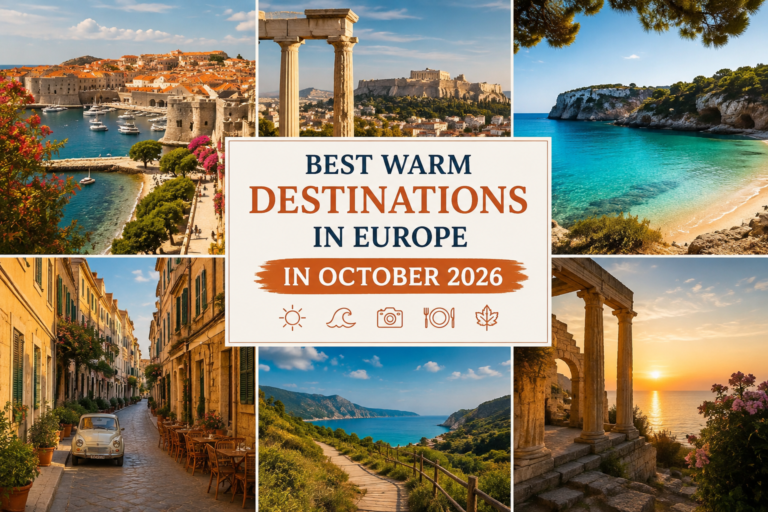
Europe in October can solve one travel problem while creating another.
The summer crowds have eased in many places, temperatures are often more comfortable for walking, and popular destinations can feel less pressured than they do in July or August. But choose the wrong destination and “quiet” can mean something very different: restaurants operating reduced hours, fewer transport options, seasonal businesses closing, or a rural area that simply does not have enough to keep you occupied for several days.
That is why choosing a destination for Europe in October should not be based on crowd levels alone.
For a slower trip, the better question is:
Can I stay here for several nights, explore nearby places without constantly packing my bag, eat well, find things to do on a slower day, and still have enough local life around me?
The six areas below were selected with that question in mind. They are not simply Europe’s most beautiful small towns or another list of famous October destinations. They are places where a traveler can build a trip around one useful base, a few worthwhile day trips, local food, nature, history, and time without an overloaded itinerary.
And there is an important distinction throughout this guide:
The best quiet destination is not the emptiest destination.
A place with fewer tourists but almost no open services is not necessarily better for a four-day trip.
Quick Comparison
| Destination | Best For | Ideal Stay | Car? | October Strength | Main Watch-Out |
|---|---|---|---|---|---|
| Inland Istria, Croatia | Food, wine, villages | 3–4 nights | Helpful | Truffle season and countryside | Rural transport |
| Alentejo, Portugal | Food, wine, history | 3–5 nights | Recommended | Spacious landscapes and slower pace | Distances between places |
| Abruzzo, Italy | Nature, villages, food | 4–5 nights | Strongly recommended | Mountains, parks and autumn food | Weather varies by altitude |
| Extremadura, Spain | History, food, culture | 3–4 nights | Helpful | Comfortable sightseeing season | Larger distances |
| Nafplio & Peloponnese, Greece | History, coast, day trips | 4–5 nights | Helpful, not essential | One-base exploration | Temptation to over-plan |
| Lake Bohinj, Slovenia | Nature, walking, scenery | 3–4 nights | Helpful | Autumn landscape | Wetter, cooler conditions |
What Makes a Place Good for Slow Travel in October?
A destination does not become a good slow-travel destination simply because it is less crowded.
For this type of October travel in Europe, I would look for several things working together.
1. Enough to do for several days
You do not need twenty attractions. You need enough variety to create different kinds of days: a town day, a nature day, a food-focused day and perhaps a nearby excursion.
2. Accommodation that makes staying longer practical
A destination works better when you can find hotels, guesthouses, rural stays or apartments that are still operating in October, and you can easily explore places to stay that remain fully open and welcoming long after the summer crowds have cleared.
3. Restaurants and cafés that remain part of local life
This matters more than having a long tourist attraction list. A slower trip depends on being able to have an unplanned lunch, linger over dinner and find somewhere open after a day exploring.
4. Reasonable transport
Some of the best slow-travel areas are genuinely easier with a car, That is not a flaw, but it needs to be made clear before you book.
5. Day-trip potential
The ideal base gives you options without requiring a hotel change every night.
6. Weather that fits the activities
A rainy October day is much easier to handle in a historic city with restaurants and museums than in an isolated mountain village where your plan depends entirely on hiking.
7. Something seasonal
Autumn food, harvest landscapes, walking conditions, local markets or changing scenery can make October feel like a reason to visit rather than simply a cheaper version of summer.
This is the central principle:
Quiet because it is pleasantly less crowded is good. Quiet because the season has ended is a planning problem.
1. Inland Istria, Croatia
Why It Made the List
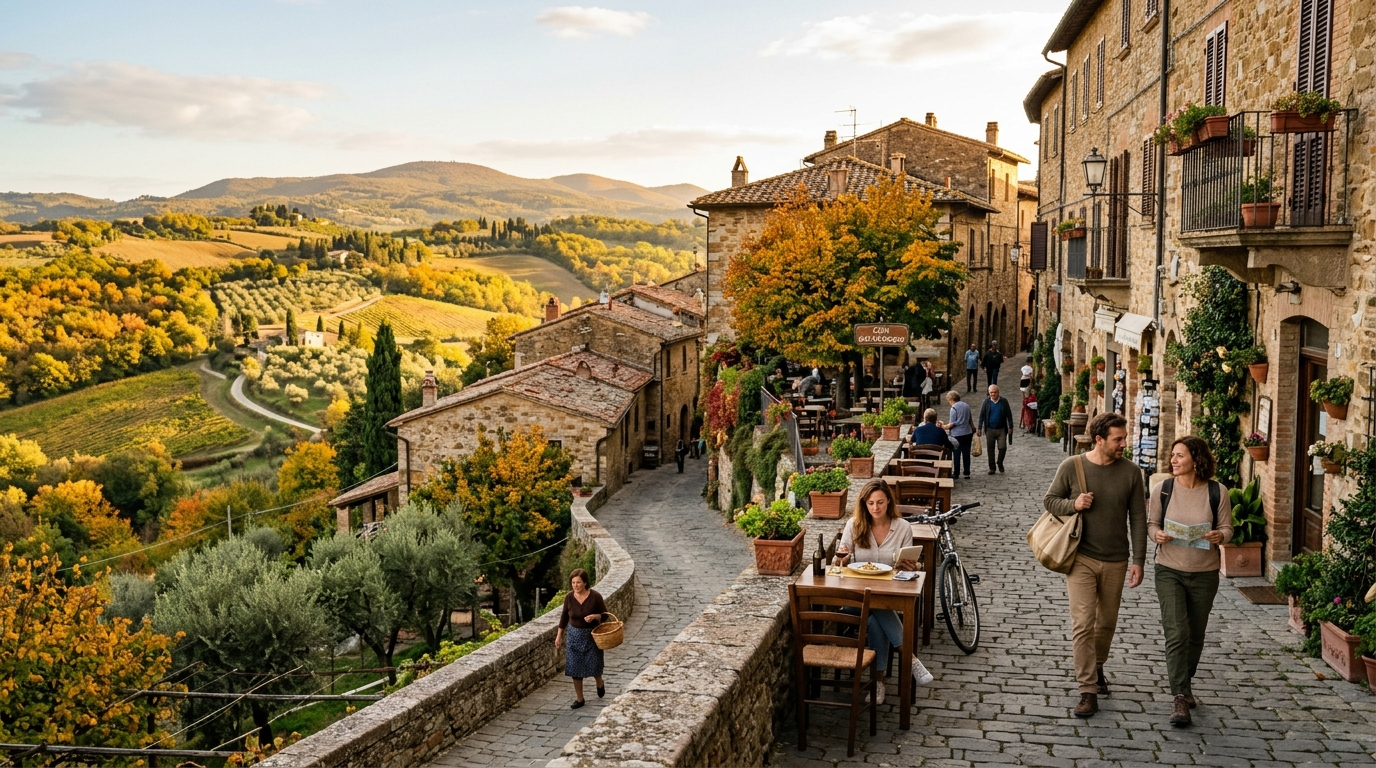
If your idea of a good October trip involves eating slowly, visiting hill towns, driving through countryside and spending more time at the table than checking off attractions, inland Istria is one of the strongest choices.
The focus here is deliberately away from Croatia’s famous coastal hotspots.
Motovun, the Mirna River valley, Livade, Buzet and smaller hill towns such as Oprtalj create a very different experience from a summer coastal itinerary. Motovun itself sits above the Mirna valley and is one of the defining historic towns of inland Istria.
October also has a genuine culinary reason to visit: the official Istria tourism authority identifies October as the peak season for white truffles.
For 2026, the regional calendar includes truffle-related events in October, including the Teran and Truffle Festival in Motovun on October 17–18 and the Tuber Food Fest in Livade on October 24–25. Zigante Truffle Days run from October 3 to November 1.
The October Reality
The advantage is not simply “fewer tourists.” It is that autumn gives the inland region a stronger seasonal identity.
Food becomes a reason to structure your days. You can visit a hill town in the morning, have a long lunch, explore a winery or countryside area and return to your base rather than trying to fit four towns into one day.
But October does not turn inland Istria into a completely empty region. Certain weekends, particularly around food events, can still be busy.
The Problem Travelers Should Know
A car is extremely useful.
The region’s appeal comes from the spaces between towns, and public transport is not the easiest way to build a flexible countryside itinerary. That does not mean you need a car for every day of a longer Croatia trip—though comparing local car rental options ahead of time makes managing those regional stretches much simpler—and it means you should not choose an isolated rural accommodation assuming local transit will be effortless.
A Better Way to Experience It
Stay in one base for three or four nights.
Use one day for Motovun and the Mirna valley, another for Buzet or Oprtalj, and leave one day flexible for food, wine or weather.
If truffles matter to you, check the official 2026 event calendar before choosing your dates rather than assuming every October weekend offers the same experience.
What to Skip
Do not try to combine inland Istria with a long list of Croatia’s famous coastal destinations in the same short trip.
That turns a slow trip into a driving itinerary.
Consider This Instead
Instead of treating Motovun as a quick photo stop, use it as part of a northern Istrian base and explore the surrounding countryside.
Where to Base Yourself
A small town or countryside accommodation near the Mirna valley works well if you have a car.and you can easily browse regional guesthouses and apartments to find a reliable base that remains fully open in October.
If you do not, choose a more service-rich town rather than an isolated farmhouse.
How Long Should You Stay?
3–4 nights is enough for a focused slow trip.
Five nights can work if you are particularly interested in food, wine and countryside exploration.
Who Is This Best For?
- Couples
- Food-focused travelers
- Solo travelers comfortable with driving
- Travelers who enjoy villages and countryside
- Families who prefer flexible days
Travelorya Take
Inland Istria works because October gives the region something to do rather than simply taking tourists away. The truffle season makes the timing meaningful, while a one-base approach prevents the region from becoming another road-trip checklist.
2. Alentejo, Portugal
Why It Made the List
The Alentejo is almost tailor-made for travelers who want space between experiences.
Portugal’s official tourism information describes the region through its broad landscapes, cork and olive trees, walled towns, vineyards and slower pace. Évora and towns such as Monsaraz provide enough history and culture to give a rural trip structure.
This is important because a slow trip still needs substance.
You could spend a few nights around Évora, then use day trips to explore smaller settlements and the countryside rather than changing hotels every day.
The October Reality
Historically, October is a transition month rather than guaranteed summer weather. Évora’s long-term climate data shows a wetter October than the dry summer months, so outdoor plans should have some flexibility.
The reward is that the region’s appeal is not dependent on beach weather.
A historic center, winery, village, meal or countryside drive can still make a worthwhile day when conditions are not perfect.
Monsaraz is particularly useful for this style of trip. Its medieval streets, castle, surrounding landscape, wine country and access to the Alqueva area provide several different experiences without requiring a new hotel every night.
The Problem Travelers Should Know
Distances can be deceptive.
The Alentejo feels spacious because it is spacious. A map may make several villages appear close together, but a slow itinerary becomes less relaxing if every day involves long drives.
A Better Way to Experience It
Choose a base and organize your trip around a small geographic area,taking time to compare regional hotels and rural apartments that suit your preferred pace.
Évora works well if you want a stronger supply of restaurants, accommodation and historical attractions, while a countryside stay near Monsaraz can be better if the lodging itself is part of the experience. The key is to decide whether you want convenience or immersion before booking.
What to Skip
Do not attempt to cover the entire Alentejo in four days.
And do not choose a remote countryside property simply because it looks peaceful if you will spend every evening worrying about where to eat or how to get back.
Consider This Instead
If you want the countryside atmosphere without sacrificing convenience, use Évora as your main base and make selected day trips.
If you want a more rural experience, stay near Monsaraz or another established regional town and accept the need for a car.
Where to Base Yourself
Évora: best for convenience, history, restaurants and a more walkable urban base.
Near Monsaraz: better for countryside, wine, landscapes and a more rural stay.
Countryside accommodation: excellent when the property itself is part of the holiday.
How Long Should You Stay?
3–5 nights.
Three nights works for Évora plus nearby excursions. Four or five nights makes more sense if you want the countryside to be part of the trip rather than something you see through a car window.
Who Is This Best For?
- Couples
- Food and wine travelers
- Families wanting space
- Travelers who like history
- Older travelers who prefer a slower sightseeing rhythm
Travelorya Take
Alentejo is one of the strongest examples of why slow travel does not mean seeing less. It means making the distance between experiences part of the trip.
3. Abruzzo, Italy
Why It Made the List
Italy does not need another argument for visiting its most famous cities.
Abruzzo offers a different proposition: villages, mountains, protected landscapes, local food and access to both the Apennines and Adriatic coast.
The regional tourism authority highlights villages, food and wine, nature, hiking and protected areas as central parts of the destination. Abruzzo also contains three national parks and a marine protected area.
That combination makes it particularly suitable for travelers who want several different types of days.
The October Reality
October can be pleasant for exploring lower and mid-elevation areas, but Abruzzo’s geography matters.
Historical climate data shows significant variation across the region. Coastal areas such as Pescara can have relatively mild October conditions, while higher locations become considerably cooler and wetter.
So do not treat “Abruzzo weather” as one single forecast.
The Problem Travelers Should Know
You need to respect geography.
A village in the mountains and a coastal town can have very different conditions on the same day.
This is also a region where driving makes a major difference if your goal is to connect villages and natural areas efficiently.
A Better Way to Experience It
Choose one area rather than trying to see all of Abruzzo, and secure a flexible vehicle rental if you plan to navigate the winding roads between mountain villages efficiently. A four- or five-night road trip can combine a hill town, a national park day, local food and a slower village day without requiring a new hotel every evening.
What to Skip
Do not attempt a “greatest hits of Abruzzo” itinerary in a few days.
Also avoid scheduling every day around mountain hiking. October weather can change the usefulness of higher trails, and a good slow itinerary needs alternatives.
Consider This Instead
Choose a base with restaurants and basic services, then drive into smaller villages and protected areas.
That gives you the benefits of rural Abruzzo without becoming dependent on a remote property.
Where to Base Yourself
Look for a small regional town or accessible village rather than the most isolated accommodation you can find, and explore available local guesthouses and apartments to find a spot that keeps you close to everyday amenities. The best base is one that gives you somewhere to eat in the evening and reasonable driving access to the countryside.
How Long Should You Stay?
4–5 nights works particularly well.
You can shorten this to three nights if you are focusing on one small area.
Who Is This Best For?
- Nature lovers
- Food-focused travelers
- Couples
- Families with older children
- Travelers comfortable with a rental car
Travelorya Take
Abruzzo is the Italy choice for travelers who want the landscape and food without building the trip around Italy’s famous city circuit. Just give the geography the respect it deserves.
4. Extremadura, Spain — Cáceres and Surrounding Areas
Why It Made the List
Extremadura is useful for travelers who want a quieter side of Spain without sacrificing history, food or basic travel infrastructure.
Cáceres gives you a proper historic-city base rather than a tiny village. Its official tourism portal highlights historic heritage, museums, nature, food, routes and visitor services.
From there, the wider region opens into countryside, protected landscapes and smaller towns.
The regional tourism authority also emphasizes gastronomy, villages, protected natural spaces, birdwatching and stargazing.
The October Reality
October is historically one of the more comfortable periods for exploring Cáceres, although rainfall increases compared with summer. Long-term climate data shows October as a relatively mild sightseeing month with moderate rainfall.
That makes the region well suited to a mixed itinerary: historic streets when the weather is good, food and cultural experiences when it is not.
The Problem Travelers Should Know
Extremadura is not compact.
A traveler who chooses Cáceres as a base should not assume every interesting countryside destination is a quick walk or short bus ride away.
A Better Way to Experience It
Use Cáceres as an anchor and choose two or three excursions, perhaps adding a guided regional food tour or tasting experience to connect directly with local producers. The region’s food is also a legitimate reason to slow down, as Extremadura features a formal Cheese Route connecting farms, dairies, restaurants, accommodation and food experiences around products including Torta del Casar and other regional cheeses.
What to Skip
Do not fill every day with a different historic town.
Cáceres deserves time to explore at a walking pace, and the countryside works better when you leave room for an unplanned stop.
Consider This Instead
Choose a smaller regional town only if you have a car and want rural immersion.
For travelers without a car, Cáceres is the smarter base because it provides more services and activities.
Where to Base Yourself
Cáceres city center: best for travelers who value walkability, restaurants and history.
Countryside: better for travelers prioritizing nature, food and quiet, especially with a car.
How Long Should You Stay?
3–4 nights.
Add a fifth night if you want to explore more of the surrounding countryside at an unhurried pace.
Who Is This Best For?
- Couples
- Solo travelers
- Food lovers
- History-focused travelers
- Families wanting cultural experiences
Travelorya Take
Cáceres is the useful kind of quiet. It gives you the atmosphere of a slower region without forcing you to give up the conveniences of a real city.
5. Peloponnese, Greece — Nafplio as a Base
Why It Made the List
The mistake in the Peloponnese is not necessarily choosing the wrong destination.
It is trying to see too much.
Nafplio is particularly useful because it functions as a genuine base rather than simply an overnight stop. It has a historic center, waterfront, castles, restaurants and everyday services, while also providing access to major archaeological sites and nearby coastal areas. Greece’s official tourism site notes that Nafplio is connected by intercity buses to Athens, Argos, Corinth and nearby towns.
That makes the area workable even for travelers who do not want to drive every day.
The October Reality
The appeal here is not “Greek island summer.”
It is having enough variety to enjoy a Greek trip after the busiest beach-focused period.
One day can be devoted to Nafplio itself. Another can focus on archaeological sites such as Mycenae or Epidaurus. Another can be left for the coast, villages or a long lunch.
The Problem Travelers Should Know
The region invites over-planning.
There are too many historically important places to fit comfortably into a short itinerary.
If you turn every day into a long driving loop, you lose the exact quality that brought you here.
A Better Way to Experience It
Stay in Nafplio for four or five nights, treating the city as your home rather than a place to sleep between road trips while you browse local archaeological and coastal day tours to easily handle the logistics. The Peloponnese has substantial day-trip potential, including Mycenae, Epidaurus and Corinth-area sites.
What to Skip
Do not combine Nafplio, several archaeological sites, Athens and multiple Greek islands into one short October holiday unless you genuinely enjoy fast-paced travel.
Consider This Instead
If you want one-base Greece, make Nafplio the center of the trip, and simply arrange a short-term car rental for a few days if that makes sense rather than keeping a vehicle parked for the entire stay. You can still explore the surrounding region at your own pace without managing transit the whole time.
Where to Base Yourself
Stay in or near Nafplio’s historic center if walking to restaurants and evening activities matters.
Choose the outskirts or nearby countryside if you prefer parking, more space and a quieter accommodation setting.
How Long Should You Stay?
4–5 nights.
Three nights can work, but four or five gives the base strategy enough time to make sense.
Who Is This Best For?
- Couples
- Solo travelers
- Families
- History lovers
- Travelers who prefer walking
- Travelers without a car
Travelorya Take
Nafplio proves that slow travel does not require a tiny village. A well-connected historic town can be a much better slow-travel base because you get more choices without constantly moving.
6. Lake Bohinj, Slovenia
Why It Made the List
Bohinj is the most weather-sensitive destination on this list, but it also offers one of the strongest reasons to slow down.
Lake Bohinj sits inside Triglav National Park and is surrounded by the Julian Alps. The official Slovenian tourism authority presents it as a nature-focused destination with hiking and environmentally friendly mobility.
Autumn is particularly attractive for walking and landscape-focused travel. Slovenia’s tourism authority describes autumn as a strong hiking season and highlights Bohinj’s trails and autumn scenery.
The October Reality
This is where honesty matters.
Bohinj can be beautiful in October, but it is not the safe-weather option on this list.
Historical climate data for Bohinj shows average October conditions around 14°C during the day and 5°C at night, with substantial precipitation.
That does not mean every October day is cold or wet. It means your itinerary should be built around flexibility rather than guaranteed sunshine.
The Problem Travelers Should Know
Weather can determine your day.
A mountain destination is less forgiving than a historic city when rain arrives.
A Better Way to Experience It
Stay three or four nights and build a flexible itinerary.
Have one or two walking days, but also leave room for shorter viewpoints, villages, food and relaxed time around the lake.
For an easy autumn walk, the official Slovenian tourism site highlights Peč nad Staro Fužino, a short marked trail with views toward Lake Bohinj.
What to Skip
Do not build the entire trip around ambitious mountain hikes.
And do not choose Bohinj simply because you want “less crowded Bled.” The two destinations offer different experiences, and Bohinj’s weather demands more flexibility.
Consider This Instead
If reliable transport connections and a larger selection of attractions matter more than immersion in nature, Bled may be the more practical choice.
If your priority is landscape, walking and a slower mountain setting, Bohinj is the stronger fit.
Where to Base Yourself
Stay around Bohinjska Bistrica, Ribčev Laz or another established part of the valley rather than choosing an isolated mountain property without checking transport and services.
How Long Should You Stay?
3–4 nights.
Five nights can work for hikers and nature-focused travelers who are comfortable adapting their plans to weather.
Who Is This Best For?
- Nature lovers
- Couples
- Hikers
- Families with active children
- Travelers who enjoy photography and outdoor activities
Travelorya Take
Bohinj is the choice for travelers who value the destination’s landscape more than weather certainty. Choose it deliberately, not because you assume every Alpine October looks like a postcard.
Small Town or Larger City: Which Is Better in October?
A small town sounds like the obvious answer for a quiet trip.
It is not always the best one.
Choose a small town when:
- You have a car.
- You enjoy quiet evenings.
- Your accommodation is part of the experience.
- You are comfortable planning meals ahead.
- Nature and local atmosphere matter more than nightlife.
- You are happy to let weather determine the day’s rhythm.
This works particularly well in inland Istria, rural Alentejo and parts of Abruzzo.
Choose a smaller regional city when:
- You do not want to rent a car every day.
- You want more restaurants open in the evening.
- You are traveling with young children.
- You want museums or indoor alternatives.
- You prefer easy access to transport.
- You are staying four or five nights.
That is why Cáceres and Nafplio are particularly useful.
The lesson is simple:
A quiet regional city can produce a slower trip than a remote village if it removes logistical friction.
Early October vs Late October
The difference between early and late October can be more important than travelers expect.
Early October
Early October is generally the safer choice if you want a balance between quieter conditions and active tourism.
Some seasonal businesses are still operating, outdoor activities remain more flexible in many regions, and daylight conditions are generally more favorable than later in the month.
This is particularly useful for:
- Bohinj
- inland Istria
- Abruzzo
- rural Alentejo
Late October
Late October is better suited to travelers who actively enjoy the quieter side of shoulder season.
But you should expect greater variability.
You may encounter:
- cooler evenings
- shorter daylight
- more weather-dependent outdoor plans
- reduced seasonal services
- fewer choices in very small villages
This does not mean destinations close down on a specific date. Seasonal operations vary by business and year, so check individual opening information before booking.
Which should you choose?
Choose early October if this is your first slow European autumn trip and you want fewer logistical surprises.
Choose late October if atmosphere, food seasonality and quieter streets matter more than having every summer-oriented service available.
And remember: southern destinations such as Alentejo, Extremadura and the Peloponnese generally give you more flexibility than Alpine destinations if weather is your main concern.
How to Build a 4–7 Day Slow October Trip
A slow trip does not require spending seven days doing nothing.
It requires removing unnecessary movement.
A useful structure is:
Day 1: Arrive and settle in
Do not schedule a major excursion after arrival.
Walk around your base, find a local restaurant and learn the rhythm of the place.
Day 2: Explore the base
Give the main town your attention instead of immediately leaving.
Day 3: Day trip
Choose one nearby destination or experience.
Day 4: Flexible weather day
Keep this day deliberately open.
If the weather is good, go outdoors. If not, use it for food, museums, history or a long lunch.
Day 5: Second day trip
Choose another nearby area rather than another hotel.
Day 6: Local experience
Consider a food experience, farm visit, walking tour, or book a small-group local activity or tasting to deepen your connection with the region’s culinary traditions.
Day 7: Slow morning and departure
Do not create a complicated final day.
The key is to avoid the common pattern of:
new hotel → new town → new hotel → new town.
Changing accommodation every night creates packing, check-in and transport time that can consume the very holiday you were trying to slow down.
How to Save Money Without Making the Trip Worse
Slow travel can sometimes cost less, but only when the itinerary is designed properly.
Stay longer in one place
A four- or five-night stay can be more efficient than several one-night bookings, particularly when you browse weekly apartment rentals or extended-stay guesthouses that offer better overall value and extra space to settle in.
Stay slightly outside the main center
You can often gain more space by staying just outside the busiest historic core while remaining close enough to walk or drive in.
Use the car strategically
If you need a car for rural exploration, consider whether you need it for the entire trip, and compare short-term vehicle pick-up options to avoid paying for days when you only plan to walk around town. A car that sits unused while you explore on foot is an unnecessary expense.
Mix paid experiences with free days
You do not need a paid activity every day.
A walking day, village exploration, picnic, scenic drive or historic center can balance a food tour or guided experience.
Cook occasionally
An apartment can make sense for a longer stay, particularly for breakfast, snacks or one simple meal.
Book transport around your base
If you can eliminate two or three unnecessary transfers by staying in one place, the savings are not only financial, especially if you book a reliable private airport transfer to streamline your initial arrival and final departure. You also gain time. For an extra saving, code TPO5 takes 5% off when booking through the KiwiTaxi app.
Slow October Travel for Families
Slow travel works for families, but the best base changes depending on age.
Babies and Toddlers
Prioritize convenience over remoteness.
Look for accommodation with easy access to food, parking or transport, and practical sleeping arrangements. A beautiful isolated farmhouse is less useful if every meal requires a long drive.
Nafplio and Cáceres can be easier than very rural bases.
Young Children
Keep day trips shorter and choose destinations where a simple outdoor experience can count as the main activity.
Alentejo, Nafplio and Istria can work particularly well when the schedule leaves room for playgrounds, food stops and unplanned breaks.
Older Children
This is where destinations such as Abruzzo, Extremadura and inland Istria become more interesting.
History, food, nature and short road trips give children something to actively engage with rather than simply looking at monuments.
Teens
Teens often benefit from having some independence within a safe, walkable base.
Nafplio can provide a good mix of food, history and exploration, while Bohinj adds walking, photography and outdoor activities.
The broader rule is:
Do not make family travel slower by making it more remote. Make it slower by reducing unnecessary transfers.
When a Famous Destination Is Actually the Better Choice
There is a danger in the modern obsession with “hidden gems.”
A tiny village is not automatically better than a famous destination.
Sometimes the famous place has exactly what a slow traveler needs:
- more restaurants
- more accommodation
- better transport
- more indoor activities
- easier access to medical or family services
- more choices when the weather changes
That is why this article recommends Nafplio rather than an isolated Peloponnese village, and Cáceres rather than an extremely remote Extremaduran base for many travelers.
The same logic applies to Slovenia.
If you want a mountain setting but also care strongly about transport, restaurant choice and weather alternatives, Bled can sometimes be a more practical base than Bohinj.
And in Alentejo, Évora may be a better slow-travel base than a beautiful rural property if you do not want to drive every evening.
The goal is not to avoid famous places.
It is to avoid choosing a destination because it sounds undiscovered when it actually makes your trip harder.
The Slow Travel Test
Before booking a destination in Europe in October, ask yourself five questions:
- Can I stay here for at least three nights without feeling trapped?
- What will I do if it rains?
- Where will I eat on an ordinary Tuesday evening?
- Can I reach two or three worthwhile places without changing hotels?
- Is the place quiet because it is pleasant, or because the season has ended?
If you cannot answer those questions, keep researching before booking.
FAQ: Europe in October for a Slower Trip
Is October a good month for slow travel in Europe?
Yes, provided you choose the destination carefully. October can offer a useful combination of reduced pressure, seasonal food, outdoor opportunities and more comfortable sightseeing conditions. But conditions vary significantly between southern, central and Alpine Europe.
Where in Europe is quieter in October?
The six areas in this guide—especially inland Istria, Alentejo, Abruzzo, Extremadura, the Peloponnese and Bohinj—can offer a quieter experience when compared with Europe’s major peak-season hotspots. The important point is to choose a place that remains functional outside summer.
Are small European towns open in October?
Many are, but not every tourist business operates on the same schedule. Restaurants, attractions and accommodation can reduce hours or close seasonally, especially in very small or highly summer-dependent places. Check individual businesses before traveling.
Is early or late October better for a quieter trip?
Early October generally offers a better balance between quieter conditions and available services. Late October can be more peaceful but also more weather-dependent, with greater potential for seasonal changes.
Do I need a car for small towns in Europe?
Not always. Nafplio and Cáceres can work without a car more easily than rural Abruzzo or inland Istria, though you can always compare flexible regional car rental options if you decide to venture beyond the city center. In countryside regions, having a vehicle can provide much more flexibility.
How many days should I spend in a small European town?
Usually 2–4 nights is a useful starting point. Stay longer when the town is a strong base for several day trips or when nature, food and the accommodation itself are part of the experience.
Is slow travel in Europe suitable for families?
Yes. The biggest benefit for families is often fewer transfers rather than simply choosing smaller destinations. A practical base with restaurants, services and short excursions can be much easier than a remote village.
What is the biggest mistake to avoid when planning an October trip?
Confusing quiet with closed.
A destination with fewer visitors can be excellent. A destination where your preferred restaurants, tours and transportation have disappeared for the season may not be.
Final Thoughts: Choose the Base, Not the Checklist
The best Europe in October trip may not be the one with the most famous attractions.
It may be the one where you wake up in the same accommodation several mornings in a row, know where you want to have breakfast, take a day trip without packing your suitcase, spend an afternoon walking through a village, and leave one day completely open because the weather—or your mood—changed.
Inland Istria gives you food and countryside.
Alentejo gives you space and regional culture.
Abruzzo gives you mountains, villages and nature.
Extremadura gives you history without requiring a major-city itinerary.
Nafplio gives you a practical Greek base with archaeological and coastal day trips.
Bohinj gives you Alpine nature, provided you are willing to accept October’s uncertainty.
None is perfect.
And that is precisely why they are useful choices.
The right destination is the one whose disadvantages fit your travel style.
If you want a broader overview of seasonal European travel, see Best Fall Destinations in Europe for 2026
If you are still deciding between different types of October destinations, continue with Best Places to Visit in Europe in October 2026
And if your priority is specifically warmer weather rather than a slower itinerary, Best Warm Destinations in Europe in October 2026 is the better comparison.
Travelorya’s approach is simple: travel slower, stay longer when it makes sense, spend locally, and build enough flexibility into the itinerary that the trip still works when reality does not follow the plan.
Planning a longer October stay?
If you’re turning your European escape into a longer, slower trip, consider flexible travel insurance that can work across multiple destinations and changing plans, Check SafetyWing travel coverage